Episode 65: She Skipped Surgery for Breast Cancer. This Is Why | Dr. Toni Galardi
This episode is also available on:








In this episode of The Beljanski Cancer Talk Show, Sylvie Beljanski speaks with Dr. Toni Galardi, a psychologist, author, and burnout-recovery specialist, about her personal breast cancer journey and the emotional patterns she believes contribute to the disease.
Dr. Galardi shares how she chose to step away from a traditional surgical path after discovering a small, heart-shaped tumor in her left breast, opting instead for a functional-medicine protocol combined with deep emotional and trauma work. Drawing on her own healing and interviews with 100 women, she explores what she calls the “disease to please” — a pattern of chronic overgiving, poor boundaries, and self-neglect that she connects to breast cancer risk.
The conversation covers toxic relationships, empaths and narcissistic dynamics, occupational burnout, the emotional relationship with food and nurturing, and how Dr. Galardi works with clients to address the emotional roots that can accompany a cancer diagnosis — alongside, not in place of, medical care.
Dr. Toni Galardi
310-890-6832 and/or drtoni@drtonigalardi.com
🔑 Three Key Takeaways
- Emotional roots may play as significant a role as physical ones
Dr. Galardi’s own healing journey — including choosing high-dose IV vitamin C therapy over immediate surgery — was paired with deep emotional excavation. She believes that addressing trauma and life alignment is essential to lasting healing, even for those who pursue conventional treatment. - The “disease to please” pattern shows up again and again
Through interviews with 100 women, Dr. Galardi found a recurring theme: women who chronically overgive, sacrifice their own needs, and struggle to set boundaries — whether in toxic marriages, demanding careers, or relationships with narcissistic partners — may be more vulnerable to breast cancer. - Healing means nurturing the whole self, not just treating the tumor
Dr. Galardi connects breast health to how women nurture themselves — through relationships with food, self-care rituals, and vocational alignment. She works with clients over a 6-month period to clear emotional roots, while referring out to functional-medicine specialists for supervised protocols.
⏳ 00:00 Introduction to Dr. Tony Gallardi and her journey
⏳ 02:23 Her background and experience in holistic health
⏳ 03:08 Discovering her breast cancer and initial decisions
⏳ 04:33 The emotional significance of her tumor’s shape
⏳ 06:27 Her functional medicine protocol and tumor reduction
⏳ 09:16 The emotional and relational roots of breast cancer
⏳ 12:24 The connection between nurturing and breast health
⏳ 15:41 The disease to please and emotional stress
⏳ 18:58 The power of detox and emotional clearing
⏳ 19:50 Grieving and emotional release after trauma
⏳ 22:43 The importance of relationship with food and self-love
⏳ 25:40 Her approach to coaching and personalized healing
⏳ 30:56 Upcoming conference and holistic cancer support
Dr. Toni Galardi (00:00.076)
Organic food is important. No question it’s important to be and I do I only eat organic food. However, if you’re in a stressed out place while you’re eating the food, it’s it’s it’s so interesting. Mark Furman was being interviewed, I think was by Steve Bartlett, the podcaster, and who’s British, and he said, You know, I have a feeling and and and Mark agreed with this. He said, I have a feeling that you could have somebody whose health habits are kind of so so
But if they have a big community around them, if they’re really well loved, you know, if they’re also in healthy relationships, that they could actually live longer than the person who’s eating organically, who’s taking their supplements, you know, who’s doing all this stuff, but is completely stressed out. And he was absolutely I absolutely agree with that. I do eat organically, but I also bless my food, you know, before I eat it. I put, you know, energy over I just do like a Reiki energy, you know, trans.
than over my food when before I eat it.
Sylvie Beljanski (01:02.168)
Welcome to the Belgianski Cancer Talk Show where integrative science and holistic healing come together. I am Sylvie Beljanski and in each episode we explore nutrition, lifestyle, mental health and research-backed approaches to support the whole person through cancer and chronic diseases. Hello and welcome to the Belgian ski cancer talk show.
My guest today is Dr. Tony Gallardi, and this is an extraordinary woman I cannot wait to introduce to you. Dr. Tony Gallardi has worn many hats over the course of her 35 year career. She has a PhD in psychology. She maintains a private practice internationally with people seeking to redesign their lives out of burnout. Her past has also embraced the titles.
Of assistant professor and media expert for how to stay resilient in the midst of light quakes. I love it. With appearances on ABC, Fox, and Gaia Networks. She has also been a cable TV talk show host in Los Angeles, professional speaker at a myriad of conferences, advice columnist for Counselor Magazine, and author of three books. Her latest book, Breastquake 10 Steps to
Awakening your breast cancer to radiate health without surgery, radiation or chemotherapy. The book came out out of her own journey where she chose to step away from taking a traditional path to healing breast cancer and went about interviewing 100 women on their relationships with their breast as part of her decision-making process. This is so
Amazing so amazing. So before we get to the really the the the the meat of of it, tell me a more a little bit your own journey and and what what happened and how you you you got there.
Dr. Toni Galardi (03:08.456)
so I was fortunate in that I woke up one day and because I’m familiar with my breasts, felt a small tumor, a small mass of some kind. And and you know, with medicine as it is, it can take a while to get in to see a doctor. So it took me a while to finally get the mammogram ultrasound and all of that. And then a biopsy was ordered, and the key turning point of my decision
was standing in front of the scans with the breast cancer surgeon and she said, my God, and I’m thinking, my God, she sees something really horrible, right? She said, Your tumor is in the shape of a heart. And it was only s 1.2 centimeters. Okay. And when I look when and when she said that, I thought, this is because it was over the left breast. It was in the the upper the left breast. I thought, this is emotional. This is has to be emotional. And
I so I decided I would do a lot of, you know, research. I, you know, I looked, I talked to women who’d had lumbectomies, because that’s what was gonna I was gonna be rushed into right away. But I asked her one important question. Is this slow growing? And I tell women that all the time. Ask that question. If it’s slow growing, you have time. You don’t have to when you hear the word cancer, people get scared and they just want the doctor to fix it.
And my work is really, whether someone has breast cancer or or is coming to me for other reasons, is about teaching people self-agency, like really listening and getting getting data, getting information. So I did a lot of research and also had gone to a place called the Optimum Health Institute many years before for chronic fatigue syndrome. And I saw people with advanced cancers reversing it.
without surgery. And I just decided I was I was listening to my own guidance. And I as I said I interviewed a lot of people before I made this decision and decided that I was I made a deal with God. I said, okay, if I can do this, if I can apply body, mind, and spirit, which is my model, you know, I work with functional medicine in my practice as well. Not I refer to functional medicine people, but I can see when there’s hormonal stuff and different things going on. So
Dr. Toni Galardi (05:29.558)
I just I said, and I had just finished my second, my second book had just come out. Okay. I did not want to write another book. The last thing in the world I wanted to do was to write another book. But I said, if I can do this, I will write the book and and and tell my journey, you know. And within six months, when we scheduled an MRI, I asked her to put off the MRI. They wanted to rush me into an MRI. I said, Can you give me three months? And the Reardon protocol on the functional medicine level.
seemed to have the most data in terms of its solid background with high dose vitamin CIVs twice a week for three to four months. So they did that first. When we re we we tested me, the MRI came back and of course she didn’t say, wow, you you know it’s reduced by 70%. She said, your tumor is 500 millimeters. And I said, well, that’s that’s a 70% reduction.
She said, Well, we don’t know. We don’t know for sure because we don’t have an MRI to contrast it with. I said, that I said, so should we do another MRI in in six months or something? She said, no, we and so it was like so confusing. No, no, no. We’ll just, you know, retest you with a mammogram and ultrasound in six months. So I had to wait another six months. Well, in the meantime, this is what I discovered. And I put this in the book. You can’t find this on the internet now.
But it was on the internet at the time, okay? Which is at the University of Oslo, they have data that shows you cannot tell the difference necessarily between dead cells and live cells. People don’t know that. They don’t know that. And the reason, and so when I questioned my breast cancer surgeon about it, she said, Well, we don’t concern ourselves with that because we immediately do radiation. Mm-hmm. And so and then we don’t check for another six months because it takes six months for it to clear the s the body.
Well, the same thing is true when you high mean because it turns it with vitamin C, I so for people to know this, when you introduce high doses of vitamin C into the body, it oxygenates the tumor. The tumor goes toward because it loves glucose, so it t goes toward that vitamin C, which is g is pure glucose, and then it’s destroyed from the inside out. Well, those dead cells can take six months, just like radiation to clear the body.
Sylvie Beljanski (07:49.858)
Yeah, we we see we see the same thing with Paupera and Rovolfia extracts, which are the active ingredients in woman and women in France. It’s also very it takes forever to get sometimes appointment with with doctors. So we have those frantic phone calls of ladies telling us, I’m just being diagnosed, I’m not going to see the doctor for three months. I don’t want to have this monster growing in inside me for three three more months.
We give that tell them to take, you know, some so some woman and then they still have surgery, but they tell us the doctor is surprised. Everything was was necrosis. It was tum tumor was dead. It was not growing anymore, but the cells die and they stay there and indeed it takes a long time for the body to eliminate that. So I’m not surprised that it it’s showing as as a tumor.
Even if it’s not active anymore.
Dr. Toni Galardi (08:47.318)
Right. And people don’t know that. They don’t know that. They’re going on what the doctor’s telling them, you know, which is what she said to me was, Well, now it’s so tiny, it would take nothing for me to go in and just scoop it out. I said, Really? Just scoop it out. Well, when you open the body, is it not true that you then have to radiate? Right. So these are things people don’t understand. But there’s also the emotional piece. I did a deep excavation with myself on childhood trauma.
things, you I was the eldest child, four children, and had responsibilities. At a very young age, my childhood was pretty much gone by the age of 11. And so I did a lot of deep work. The relationship I was in was not really in alignment with who I was. And I was staying in keeping myself small in the relationship. And now we know from there’s a whole chapter I have in Breastquake, there’s a whole chapter I have of on relationships. And they did a study in China.
With because these studies aren’t done here. You know, that’s if it’s not pharmaceutically yeah, pharmaceutical company d doing it, it’s very hard to get a study done. So they did a study because women suddenly in their forties were getting breast cancer. Never before had they seen this in China before. So they wanted to find out what was the common factors. It was not socioeconomic class, it was not what they ate. The thing that most of the women had in common were they were in a toxic American.
Sylvie Beljanski (10:13.742)
When cancer enters your life, the questions don’t stop at treatment. You start asking why, what else, and what more can I do to support my body? At the Belgianski Foundation we believe cancer care deserves deeper answers. Answers rooted in science, not in shortcuts.
For decades, groundbreaking molecular research by Dr. Mirko Beljanski explored how specific natural compounds selectively target cancer cells while sparing healthy ones. That work continues today through independent research, education, and global collaboration.
At Belgianski.org, you will find evidence-based resources, expert-led conferences, books, and conversations that explore integrative approaches to cancer and chronic disease alongside conventional care. Whether you are a patient, a caregiver or practitioner, this is the place to learn, to question and to think more expansively about healing.
Visit Beljanski.org to explore the research, attend upcoming events and connect with the Belgianski community. Because informed choices begin with credible science.
Dr. Toni Galardi (11:31.926)
And so we know, and in fact, Jen Simmons, Dr. Jen Simmons, who will be one of your speakers at your conference, it wrote the forward to this book. And she said, you know, that every, you know, patient that she had coming in was in some kind of very toxic relationship. So we know this plays a huge, huge role. Your the environmental toxins, huge role. I discovered I had there was mold in the soil outside of the house. People think of the house, right?
environmental toxins in your house. But guess what? In places where it’s hot and humid in the summer and it rains, like the South, very toxic, estrogen driven molds can grow in the soil. Yeah. So
Sylvie Beljanski (12:15.522)
Yeah. So you have a tumor in this shaped like a heart and
Dr. Toni Galardi (12:20.107)
I have a little heart. I just have a little h glowing heart on the cover.
Sylvie Beljanski (12:24.408)
You have chosen the title of this interview, and I love it. Self-inch Women Don’t Get Breast Cancer. Healing the disease to please as part of the healing journey of breast cancer. Absolutely love it. So, what have you heard? learned exactly by interviewing all those women. You have interviewed women with breast cancer. You have also interviewed women who did not have breast cancer. Where did that take you? And how did that change your
Dr. Toni Galardi (12:54.444)
I also looked at I also looked at interviews that had been done with famous women who had had breast cancer, 35 famous women, you know, from Hollywood and leadership positions and whatnot. And what I kept hearing over and over again was they had they had to take a look at what they realized was how much they were overextending to others, putting others’ people’s needs first. And that this was a pattern. That’s why I said
I don’t I haven’t seen women who really take really good care of themselves, r really are good at self-care. And in the profession, you know, of of medicine, I mean I have a whole chapter on occupations because I studied occupations that were the most vulnerable to breast cancer. My own gynecologist, when I gave her my book, said, I don’t I don’t think I want to read this chapter. I think I know already which profession it is. And she was right. You know, physicians are
you know, exponentially higher incidence of breast cancer. Because you’re giving all day. And with the medical corporations now running the show, you know, it’s become a very difficult profession to be in, you know, a lot of burnout. And in fact, orthopedic surgeons were the highest of all. So Yeah. Women who are orthopedic surgeons.
Sylvie Beljanski (14:08.568)
Topedic surgeons.
Wouldn’t you, wouldn’t you? And do you think that the workplace itself plays a a role or it just no, it’s because it sounds like a a little bit s simplification, just the title.
Dr. Toni Galardi (14:26.51)
Huge role because you’re giving, you know, women are naturally more giving. We still make 75 cents on the dollar for the average man. we’re doing, you know, that’s 70%. We know 70% of women are people who are below the poverty line are women, 70%. So we’re women, the working poor are having to work a lot harder. But not just the working poor. I, my clientele are people who are in advanced.
positions, you know, at Microsoft and various corporations, and they’re having to put in these long hours and then come home and take care of children, you know, and take care of whatever. So putting their needs first, it’s become more and more difficult. The the companies out there are expecting more and more and more if you’re going to advance, you know. And so plea but the pleaser personality is the one that I’ve heard over and over again, even in with celebrities who have lots of money.
Cheryl Crow is an example of that. She said she realized she was constantly overgiving. But anybody who needed her help, she was giving to. You know. So this this disease to please can can actually be lethal.
Sylvie Beljanski (15:41.09)
Yeah. And on top of that some are in toxic relationships. Not only they are giving, but they are sabotaged emotionally by the relationship. Does that increase the risk of breast cancer? Is there any study about that?
Dr. Toni Galardi (15:56.942)
So the only study, as I said, that has really been a tangible study that has been done is this one in China that I found anyway that showed that these women were in relationships that these are women in their 40s, so you have to know they probably have small children, right? So they’re they’re they’ve got a a partner who is doing very little. The other thing I know clinically is that empaths, so women who tend to be sensitive.
t tend to be give over givers, tend to to take care of other people. Empaths often attract narcissistic personality disorder individuals. Okay. So when you see that combination over and over and over, I was just actually in a text conversation with a friend who has who has breast cancer. And she chose to go because the tumor had gotten so big to let the chemotherapy she’s in Puerto Rico now reduce the the tumor.
And she said, I know the price I paid for being involved, being married to a man who absolutely was a narcissist. That she was because you get hooked into if you’re an empath, you get hooked into giving more. They take more, you give more. And that can be the dance. Now, this isn’t just partners, by the way. This could be a boss who’s expecting this. This could be your twenty two year old son or daughter.
Who you’re constantly doing or getting out of trouble or something like that. But the taking stock of your relationships and how much are have you let your boundaries be crossed is really key to understanding that this isn’t just emotional and your mental health we’re talking about. This can translate into cancer.
Sylvie Beljanski (17:41.186)
Yeah. it’s if life becomes too hard, too heavy, what will you do to escape that hell? You get sick and then not only you get all the attention and suddenly everybody is nice to you, but eventually you die and you escape s to the problem without having to face it ever, of course.
Dr. Toni Galardi (18:04.558)
Look at look at you know when you look at all the films on a woman who has breast cancer, what makes it, you know, a tragic, dramatic film? She loses her hair, she goes gaunt, she looks horrible. In the face of breast cancer, in the middle of fighting breast cancer, I have a picture of it of me glowing. Why was I glowing instead of my hair become going because I detoxed? You know, I did coffee enemas.
I did juice fast. I did, you know, just a lot of antioxidant foods, cut my meat consumption way down to like I was went to being a pescatarian for that period of time, you know. So there was a lot of things that just created and meant meant more of a meditation and and clearing out emotional stuff. Well, I was glowing. People didn’t believe me when I said I had.
Sylvie Beljanski (18:58.92)
It’s really really important when you speak of detox to have both the physical and emotional detox. They they really go hand in hand. So we we have spoken of relationships, to toxic relationships. What about losing the rela a relationship, a traumatic loss? What what happens? How is that I mean people responding to that?
Dr. Toni Galardi (19:20.45)
So common to see breast cancer show up a year to two years after a relationship is over, you know. And I went through that myself. So it’s very common. And that’s why what’s important is when you get a breast cancer diagnosis or before you ever get breast cancer, if you’re going through a breakup, do the emotional work to to grieve properly. Give yourself permission to feel anger, to feel sadness, to feel the entire
five stages of grief. You know, my work in the when I was doing internships in my early career in the hospice, and I was working in a freestanding hospice, I got a model for how important it is to grieve, even when at the end of life, you know, full, full on grieving. So that’s really and doing clearing, you know, I do somatic work with my clients. So I’m I’m finding where it is in the body that that is being held. Where’s that old trauma, new trauma, whatever trauma?
is being held in the body and we want to clear that and teach people how to do it themselves.
Sylvie Beljanski (20:25.006)
When you are facing cancer, the choices can feel overwhelming. Conflicting advice, endless options, and very little clarity. At Maison Beljanski, everything begins with science. For decades, molecular biologist Dr. Mirko Beljanski studied how specific plant extracts interact with cancer cells. Work that continues today through independent research and real-world use.
Maison Belgenski offers carefully formulated supplements inspired by that research, along with targeted support for immune health, cellular resilience, digestion, detoxification, and overall wellness. You will also find educational books, organic teeth, personalized health coaching, and wellness programs designed to support the whole person, not just a diagnosis.
This is not about quick fixes. It’s about informed choices, thoughtful formulations, and supporting the body alongside conventional care. Explore the products, the research and the resources at maisonbeljanski.com because when science leads, wellness follows.
Sylvie Beljanski (21:43.342)
And in your book you also address the other relationship which is important in in our life, which is with food. You have a a chapter called Nourishing, Nurturing Negation, and you’re saying that the the relationship with the food matters even more than the quality of the food itself, which is kind of surprising. So can you tell us more ab about that and how actually you think it is important to choose organic food?
Dr. Toni Galardi (22:13.58)
Yeah. So organic food is important. No question it’s important to be and I do I only eat organic food. However, if you’re in a stressed out place while you’re eating the food, it’s it’s it’s so interesting. Mark Furman was being interviewed, I think was by Steve Bartlett, the podcaster, and who’s British. And he said, you know, I have a feeling and and and Mark agreed with this. He said, I have a feeling that you could have somebody whose health habits are kind of so so.
But if they have a big community around them, if they’re really well loved, you know, if they’re also in healthy relationships, that they could actually live longer than the person who’s eating organically, who’s taking their supplements, you know, who’s doing all this stuff, but is completely stressed out. And he was absolutely I absolutely agree with that. I do eat organically, but I also bless my food, you know, before I eat it. I put, you know, energy over I just do like a Reiki energy, you know, trans.
Over my food when before I eat it. And so taking the time to slow down, you know, and and really give time. But there’s also a deeper thing that you’re talking about, which is the relationship with food is very connected to the relationship to our breasts. Okay. Because the breasts are about nurturing. So are we nurturing ourselves? You know, do you talk to your breasts?
You know, do you do you love your breasts? Do you do a ritual every day of loving your body? When I did this interview, I was shocked by how many w you know, th these hundred women I interviewed, how many women had a conflicted relationship with their breasts and had eating disorder issues or had had as, you know, teenagers and young young adults. So there’s definitely a connection.
Sylvie Beljanski (24:04.174)
Food is associated to stress, I mean compulsive eating is associated to stress and then nurturing is therefore associated to stress and it seems like a very difficult situation to escape in from.
Dr. Toni Galardi (24:19.778)
We think nothing if a woman has had a baby, she thinks nothing of breastfeeding on demand for two years, right? But doesn’t think ever of giving that to herself. Like taking the time every day. I take the time every day to talk to my breasts, to tell them I love them and and how how much I appreciate their radiant health. That’s how that’s the kind of prevention of any kind of further issues. So that nurturing
then translates to your relationship with food. I really believe that.
Sylvie Beljanski (24:52.526)
So can you tell me a little bit w I mean what is a journey with your clients when somebody somebody is I mean listen to this podcast and says my this is awesome. I absolutely want to to become a patient of of this doctor. Wha what’s the process?
Dr. Toni Galardi (25:11.576)
So let me just first say that if what they’re specifically wanting is a functional medicine doctor, you know, to do the functional medicine piece, I refer, you know, there’s lots of breast cancer coaches out there who have no background, you know, and I’m not I and maybe because I’m a licensed professional, I’m very clear about my lane. And so if somebody wants a functional medicine doctor to manage them, I send them to Jen Sim Simmons. Okay. However
But I work very well in that system because I used functional medicine. And so if somebody comes to me and what they’re dealing with are is the emotional impact of trying to make this decision. And throughout my book, I give women permission to make whatever decision feels right for them, whatever they can get behind. I love Bernie Siegel’s work, Love Medicine and Miracles, because he talks about placebo effect, right? Get behind what you can absolutely, you know, feel good about. And so
I help women figure that out. Help women figure out what is it that is is gonna be in their highest good, number one. I help them with the trauma, clearing out old trauma, the trauma that’s in their life right now. And and this is an important piece, their vocation. Are they doing something that they feel soul aligned with? It may be that what you were doing, you know, you have golden handcuff syndrome. A lot of people come to me with golden handcuff syndrome, which means
They’re getting paid very well. They have lots of benefits. And it’s a prison. You know. So I my work is all about I had a woman come to me, was 58 years old. And the first thing she said to me was, she was working on Wall Street, which is in New York, because I work with people all over the world. And she said to me, I I just want you to know I’m not leaving my job for four years. I said, Fine. I don’t have an agenda about when you’re gonna leave your job. And she was gone in a year. She
That and that came through her, you know, through us kind of teasing out what she really wanted in her life. And she has a farm in Portugal now. This was somebody who had a Central Park apartment, you know, and left that whole life behind to create a food, you know, f fruit building, you know, farm in the the oligarf. So and she’s happier than a clam. So it all depends on the individual, but I can tell you.
Dr. Toni Galardi (27:37.976)
That if you’re miserable in your job, it’s gonna, it’s gonna translate to your to to your health. And if you even if you decide to do a traditional, like you want to do a lumpectomy or you wanna do chemotherapy or radiation, whatever you choose, you want to do, if you don’t deal with these emotional roots, right? If you go back to the same job, you know, it’s gonna come back. You know. So and that would be true, by the way, if you did what I do did. If you if you forego a surgery.
And you st don’t deal with the emotional roots and you just do functional medicine, chances are it can come it can come back. So that’s really key. I love what I do. I love being able to help people find what they’re truly here to do in this life and and that’s at this point in their life.
Sylvie Beljanski (28:28.482)
So about I mean making appointments with you and how many sessions? give me more more details about how it works to become a patient of yours.
Dr. Toni Galardi (28:42.476)
I give people an opportunity to to work with me in packages. So I know that we need to work together for six months. That’s just I’ve tried doing this in three months time and we just scratch the surface because there’s often so much that hasn’t been dealt with, you know. And so I give people a deal by working with me in a package, you know, 24 sessions. And and I work by phone or Zoom.
You know, I have two clients right now who are in Australia. So, you know, it can be anywhere in the world. And so people can call me and someone, you know, my assistant will get back and we’ll set up an appointment. So do you have I don’t know if you have my information that you know if sure. So the website is doctor Tony Gillardi dot com, which is D as in David, R is in Richard, T as in Tom, O’s in Owen.
Sylvie Beljanski (29:23.563)
See sh sh share it.
Dr. Toni Galardi (29:35.412)
N is in Nancy, I as an indigo, G as in George, A L A R D I, Dr Tony Galardi.com. If you were to just Google the Life Quake miracle, you’d find me. You know, you’ll find me. So if you don’t remember that, drtonygalardi.com, you can find me through Lifequake because I’ve been doing that work of Life Quake repurposing, helping people repurpose their life after it’s, you know, been shattered for a long, long time. And yeah.
Sylvie Beljanski (30:04.34)
Your new book is Breastquake to a weekend to radiant health without surgery, radiation or chemotherapy. Yes. And you you we are going you are located near San Diego, so we are going to see you yes at Beljanski Integrative Cancer Conference in San Diego. Can you tell us a little bit more about that?
Dr. Toni Galardi (30:27.86)
It it’s so interesting that I moved here just as I was finding out about the Beljanski Foundation and I’m going to be attending the conference and supporting the foundation by going to the gala, which is on Saturday evening, for any doctors or whoever might be coming to the conference. I’ve been telling people about the conference here who are local. So hopefully people will sign up. And I I’m excited because some of
The people I respect tremendously, the doctors in the field, Dr. Jen Simmons, who I mentioned, wrote the forward to my book, will be one of the speakers. Nathan Crane, who I adore, will be one of the speakers. So it’s gonna be an an amazing opportunity to get that what is going on, cut what is cutting edge now in the field of integrative oncology. So it’s wonderful.
Sylvie Beljanski (31:20.214)
Yeah, and the proceeds of the gala go to study breast cancer stem cells and prostate cancer stem cells. And cancer stem cells are those cells which are ignored by conventional medicine but are thought to be responsible for cancer relapse. So having a natural non-toxic solution is very, very important to to be aware of those d starting from day one of diagnosis and they will give you the time to
Do all the emotional work Dr. Tony Callardi is speaking about and all those things are very important working hand to hand. You cannot afford to skip one or the other actually. You need to support your body so your body has the strength and the energy to do the work.
Dr. Toni Galardi (32:08.778)
Yes, yes.
Sylvie Beljanski (32:10.262)
Yeah. So I’m delighted. Thank you. Thank you again for coming to the show, sharing all this knowledge, and we look very much forward to seeing you very soon now next month at the Belgian ski cancer conference in La Jolia in San Diego. Thank you.
Dr. Toni Galardi (32:29.826)
Thank you. Thank you for having me. This has been a lot of fun.
Sylvie Beljanski (32:33.358)
Thank you for listening to the Beljanski Cancer Talk Show. If this conversation supported or inspired you, please follow the podcast, share it with someone who may benefit, and leave a review to help others discover these integrative perspectives. For more resources and to see what we offer, please visit beljanski.org.
Dr. Toni Galardi holds a PhD in psychology and has spent 35 years working as a private practitioner, assistant professor, media expert, TV talk show host, professional speaker, and advice columnist. She is the author of three books, including her latest, BreastQuake: 10 Steps to Awakening Your Breast Cancer to Radiant Health Without Surgery, Radiation or Chemotherapy, written after her own breast cancer healing journey. Dr. Galardi works with clients internationally, helping them clear emotional and trauma roots and realign with their vocation and life purpose.
Dr. Toni Galardi
310-890-6832 and/or drtoni@drtonigalardi.com
Connect with Dr. Toni Galardi

Website



YouTube
Related Episodes
Episode 35: Toxic Overload: The Hidden Link Between Toxins, Autoimmunity & Cancer with Dr. Loretta T. Friedman, RN, MS, DC, CCN, CNS, DACBN, DCBCN
Dr. Friedman joins the show to share some crucial health tips, specifically regarding the lymphatic [...]
Stream Now
Episode 5 – The Power of PEMFs in Revolutionary Cancer Care with Dr. William Pawluk, MD, MSc
In this episode, Sylvie and Victor, along with Dr. William Pawluk, discuss the benefits of PEMFs, magnetic therapy, and the impact of conventional [...]
Stream Now
Episode 33: Two Presidents with Prostate Cancer; Two Different Approaches to Treatment with Sylvie Beljanski & Dr. John Hall, PhD
Explore how Biden and Mitterrand faced prostate cancer—and why hidden science on stem cells may hold the real key to treatment [...]
Stream Now
Episode 13 – Revolutionizing Cancer Care With Personalized Testing with Dr. Lauren Cohen, DC
Dr. Lauren Cohen discusses how RGCC's personalized cancer testing tailors treatment to individual genetics. [...]
Stream Now
Keep yourself updated!
Sign up below if you want to hear more about the weekly updates of The Beljanski Cancer Talk Show!
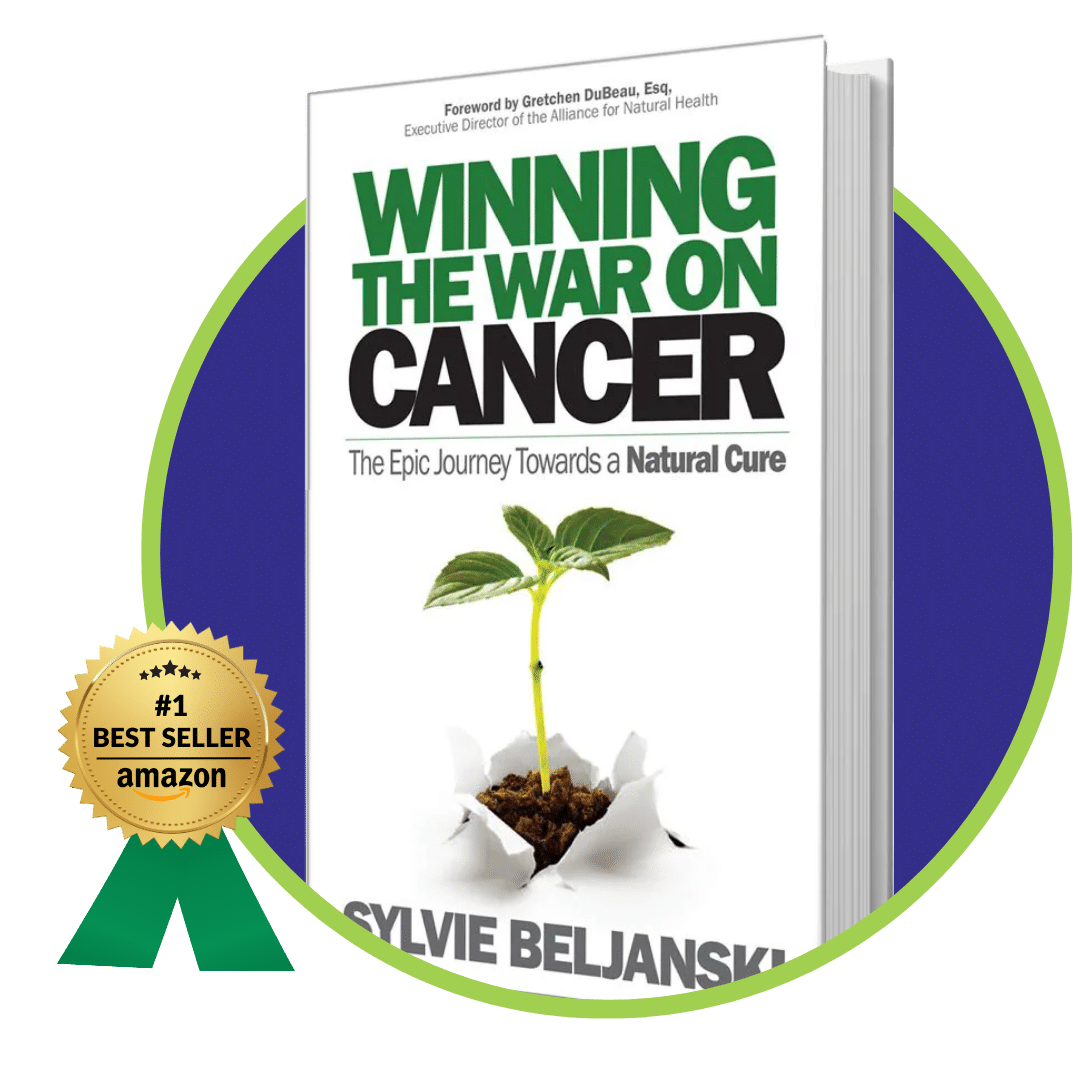
Award-Winning Book On Naturally Fighting Cancer
“For me personally, I think that Winning the War on Cancer by Sylvie Beljanski is one of those books that people should read. I have for a long time believed more in natural remedies than pharmaceutical cures, so I was involuntarily drawn to read the book.
It still preys on my mind on how the government can take up war against something that can save a lot of lives. I mean I know that a sort of thing like a more natural cure would likely actively threaten the pharmaceutical industry, but isn’t the industry on the side of saving people with something that has very little, or indeed no, toxicity at all? It’s so eye-opening and harrowing and I can’t yet state how I feel about everything that I learned.
I would recommend the book to anyone because many people these days are constantly being kept in the dark about natural remedies. What I love most about the book is that, though the book’s main point is cancer and its treatment, it also touches on areas that are vital to leading a healthy life. It points out the importance of detoxifying our body, especially since we live in a world where toxins are constantly released into the air by our technological marvels.”
4 out of 4 stars – Review by Nmesoma – OnlineBookClub.Org