
Episode 50: Sleep, Stress, and Hormones: The Terrain Behind Women’s Health
This episode is also available on:








Most women know something is wrong long before a diagnosis ever arrives. In this episode of the Beljanski Cancer Talk Show, Maraya Brown explains how subtle symptoms, disrupted rhythms, stress, and hormonal imbalance shape women’s health, and why listening to the body is the first step toward real healing.
🔑 Three Key Takeaways
- Discover how symptoms like fatigue, poor sleep, brain fog, mood changes, and inflammation are meaningful signals, not random inconveniences.
- Understand why stress, disrupted circadian and infradian rhythms, and nervous system dysregulation shape the internal terrain where disease develops, including cancer.
- Learn how functional testing, self-advocacy, and personalized support help women move from survival mode into sustainable energy, safety, and vitality.
⏳ 00:00 Understanding Women’s Health Challenges
⏳ 11:08 The Importance of Self-Advocacy in Healthcare
⏳ 14:19 Integrative Approaches to Cancer Care
⏳ 19:11 Navigating Hormonal Health and Cancer
⏳ 30:06 Empowering Older Women in Health
⏳ 35:27 Resources for Women’s Health Empowerment
Maraya Brown (00:00.362)
On average, it takes a woman four to six years for an accurate diagnosis. Often that same woman has seen four to five different providers before being believed.

Welcome to the Beljanski Cancer Talk Show where integrative science and holistic healing come together. I am Sylvie Beljanski and in each episode we explore nutrition, lifestyle, mental health and research-backed approaches to support the whole person through cancer and chronic diseases. Hello, Mariah. I'm delighted to have you today on the Beljanski Cancer Talk Show. For the audience, let me introduce you.

Maria Brown is a certified nurse, midwife, and she's a founder and CEO of Beyond Health International. She specializes in women's energy, hormonal health, libido, and nervous system regulation using a functional and integrative medicine approach. With a background in conventional medicine and advanced training in root cause physiology, Maria works with high performing women to restore vitality

through circadian and deep radian rhythm alignment, stress reduction, and personalized functional testing. She's a host of the Women's Vibrance E-code podcast, and she's known for bridging science and embodiment to help women move from chronic stress and exhaustion into sustainable energy, safety, and desire. So what a program.

I love when you say the word desire with your French accent. not going... I'm sure I botched that, but that's fun.

Sylvie Beljanski (01:49.646)
So, yes, I was delighted to have you, the idea of having you as a podcast because I think women are very often dismissed in conventional care and having somebody like you who takes care of understanding what is specific about women, about their stress, about their understanding, their vital signs is really, really important. How do you recognize that in a woman?

that something is off, the energy is not aligned where it should be, and that she needs help.

Yeah, it's a great question, especially because modern oncology is exceptional at targeting disease, but it really often underestimates the environment the disease exists in. And I think many women go dismissed. And so I listen and I pay attention to how their body is speaking. And so for some, it's subtle. They're waking up in the middle of the night. They're waking up.

in the morning feeling not well rested. They're drinking an extra cup of coffee in the day to keep going. When underneath the surface they're depleted, they're noticing increased irritability or anxiety, changes in skin, changes in weight, deep breath, right? Some are saying there's this undertone. Is it brain fog? Is it depression? I walk into a room and I don't remember why, or I'm trying to place a word and it's not.

coming, strange aches and pains or little rashes and all of it. All of it is amazing messaging from the body for women to take seriously. And what I'm sad about is how many women go dismissed. They're told, it's just part of aging. Everything is fine. Your labs look normal. But behind closed doors, if women really get quiet and really listen,

Maraya Brown (03:56.11)
to the subtle and strong cues, they actually know. They know that inflammation is up. They know that their circadian rhythm is off. They know their own infradian rhythm in this 28-day cycle if a woman is still menstruating. And they're the ones that can point it out if something feels off. And so I just love advocating for women and helping them really trust themselves.

Yes, I mean, especially high performing women, are, I mean, they will blame overload of work. They will blame deadlines. They will blame themselves because trying to put too many things on their calendar. But, or you will see an integrative doctor who will look at the hormones and say, well, maybe we can give you a little bit of this.

little bit more of testosterone or whatever. That's different from really understanding the hormonal balance of the person and the needs. It's a real choice between yourself and what is most important to you. How does it start? I mean, you have a woman who is very stressed and she says she's very busy and how do you get her to a place where she will even be

open to rest and to listen to herself.

Yeah, it's such a great question because in many societies, it's not, it doesn't come naturally for women, particularly the women that I work with, right? We're really good at moving the goalposts. We're really good at serving. We're really good at doing. We're really good at being high performing. On average, let's just talk about an autoimmune condition. Okay. On average, it takes a woman four to six years.

Maraya Brown (05:53.166)
for an accurate diagnosis. Often that same woman has seen four to five different providers before being believed. So we have two things going on. Number one is

Excuse me, you say a diagnosis, what kind of diagnosis are you referring to?

Yeah, so an autoimmune condition such as Hashimoto's or Graves or Celiac's or I mean, there's a lot of different autoimmune conditions. So that's just one example, right? So what I'm the reason I'm pointing this out is we have two things going on. One is can a woman be in self advocacy enough to listen even with a busy schedule? Listen, I'm a CEO, I'm a wife, I'm an active community member and I have three young children that are 13, 11 and eight.

had a full ride scholarship at Yale University. I was in Fortune 50. Get it? And we all know what it's like to be able to be honest with ourselves and say, something's not right here. This amount of fatigue is not just because I'm working too hard. Something else is happening, right? These changes in my skin, these changes in my mood, these changes in my sleep, yes.

The stress of overdoing is impacting it, but what else is going on here? So we have that coupled with the degree to which women have to be in self-advocacy. The degree to which in mainstream medicine women are not taken seriously is a real thing. So now we're already overworked. We're already serving greatly. And now we have to continue to be in even more self-advocacy. So in my scenario,

Maraya Brown (07:39.254)
those women that come to me, first of all, they have to trust that I know what I'm talking about and I'm going to be there to hear them, hold them and advocate for them. Then when I order the tests that I order, often the data can't lie. Right? So it's one thing to say, yeah, I worked till 10 o'clock at last night. yeah, I spent a lot of time sitting at the computer. yeah, I have high stress from work. Yes. And when a woman looks at her 24 hour cortisol curve and we can see

that it's not rising in the morning and her body is not waking up preparing for the day. It's elevating through the night so she's not actually getting restorative sleep or it's flat lined because she's pushed her body too hard and now her adrenals are no longer doing anything. The data doesn't lie. So the quick answer is the same woman when she actually gets quiet for a moment to listen into her body, she can't deny the fact that something is not right and

She tends to appreciate the data. And so when we look at an actual comprehensive thyroid panel, when we look at actual inflammatory markers, when we look at actual detox markers, when we look at actual adrenal wellbeing, the data can't lie.

So, you are speaking of markers, what exactly kind of tests are you doing that differ from the standard lab tests that are often insufficient?

Yeah, one of my favorites is called the Dutch Plus Test. It's nice because my clients are all over the world and so geography is not an issue and it's a kit that gets delivered to the front door. They collect through urine and saliva and on there I can look at their sex hormones, their estrogen, their progesterone, their testosterone. I can see their adrenals over a 24-hour period. I can see

Maraya Brown (09:36.374)
When their body is getting rid of these hormones, how is it doing it? Which is something like methylation or looking at their detox pathways. In the same test, I can look at something called their organic acids, which shows me markers of gut health, their melatonin levels, their dopamine levels, their inflammatory markers. So that's one test that I really love. Another one is a GI map, which once again is a kit that gets delivered to their front door. They collect their own stool.

And I have a teen dietician, she's flown all over the world to teach clinicians how to interpret this test. She's brilliant. And we can now look at gut dysbiosis. my gosh, 90 % of serotonin comes from the gut. 70 % of our immune system comes from the gut. So no wonder she's not absorbing the nutrients from the food that she's eating. No wonder she's more tired. No wonder she's feeling a baseline sadness or...

has high inflammation in the body and aches and pains and bloating and constipation and diarrhea. So we can go to this data to look at root cause and then we have something to work with. But I don't believe women are just statistics. Yes, we want to look at the data. We also want to listen to that woman. What is your monthly cycle like? What is your 24 hour typical day look like? What are you experiencing in your body?

How is your mood? How is your fulfillment? How is your libido? How are your relationships? All of it is relevant.

Yeah. And how long in the average, how long does it take for women to get better when they start to be here to follow your advice? When you are facing cancer, the choices can feel overwhelming. Conflicting advices, endless options and very little clarity. At Maison Beljanski, everything begins with science. For decades,

Sylvie Beljanski (11:33.932)
Molecular biologist Dr. Mirko Beljanski studied how specific plant extracts interact with cancer cells, work that continues today through independent research and real-world use. Maison Beljanski offers carefully formulated supplements inspired by that research, along with targeted support for immune health, cellular resilience, digestion, detoxification, and overall wellness.

You will also find educational books, organic teas, personalized health coaching, and wellness programs designed to support the whole person, not just the diagnosis. This is not about quick fixes. It's about informed choices, thoughtful formulations, and supporting the body alongside conventional care. Explore the products, the research, and the resources at maisonbelchanski.com. Because when science leads,

Well, that's for us.

Yeah, you know, I think it depends on what they're struggling with. My preference for most women within a couple months, there's a market change. know, they're feeling more rested. They have more energy. They're struggling with less of the gut stuff. Their sleep is better. They're feeling more hormonally regulated. Maybe there's less bloating and just kind of feeling inflamed. And so we can move.

the big stuff out of the way. And then we get to start looking at, all right, what happens next? Now that you're not so exhausted and now that you're sleeping better, now we get to look at, what do you actually desire? And where are your boundaries? what's the, what does your community look like and your vision casting look like? And so depending on how women work with me, it starts with a minimum of three months.

Maraya Brown (13:30.594)
That's what I call the Women's Vibrancy Accelerator Trifecta, where we're looking specifically at hormones, adrenals, and thyroid, and just taking a swift and simple targeted approach with diet supplementation and lifestyle change, and then helping her be in self-advocacy to go back to her prescriber and maybe make some shifts or some additions. And then for the women that have

Big, big transformation. have a year-long program. And that's the women that say that year changed the trajectory of the rest of my life. But I think a minimum of two months, which is why I have that three-month program, because then we also have the month to ensure it lands and it integrates and she has a place to continue to ask her questions.

Okay.

Sylvie Beljanski (14:19.226)
And this is Belgian Cancer Talk Show, so we have a lot of people in our audience which are concerned with cancer, and specifically for this population concerned with cancer, why? I mean, very often hormones, sleep, stress are not the things we are, doctors are speaking about. I mean, the first thing is, my God, we are going to cut and then we are going to give you chemotherapy and so on.

They are absolutely not looking at the fundamental of the person and definitely not addressing the root cause. How are you helping more specifically people suffering from cancer?

Yeah, I love this question because cancer tends to focus or cancer care tends to focus on cells while sleep and hormones and stress shape, like I said earlier, the terrain those cells live in. Okay, so if we focus on sleep, the IARC classifies night shift work as probably carcinogenic.

So showing that circadian disruption is a biologically meaningful, not just a comfort issue. So yes, it's dismissed, but a woman's sleep is relevant and important, right? Melatonin isn't just about sleep. It's a circadian signaling hormone. It tells the body when to repair and rest and regulate immune activity. And of course we need immune activity in order to heal.

Right? Chronic stress. It's shaping women's physiology. It's going to alter cortisol rhythms. It's going to impair sleep. It's going to increase inflammation, reduce immune efficiency. And so this isn't just fluff, right? Just because we have a diagnosis doesn't mean that we're in crisis mode. We still have to address the foundation.

Sylvie Beljanski (16:26.318)
you are facing cancer, you are suddenly facing a myriad of questions. Questions about nutrition, lifestyle, mental and emotional support, and how integrative approaches can work alongside conventional care.

The Beljanski Integrative Cancer Conference brings the conversation together in one place. From June 26 to 28, join leading oncologists, integrative physicians, researchers, and survivors in San Diego, California for three days of science-informed all-person cancer care.

These live events expose evidence-based integrative strategies, emerging research and practical tools you can apply immediately while connecting with the communities that understand the journey. Whether you attend in persona virtually, this conference is designed to educate, empower and support informed decision-making. Learn more and reserve your spot at integrativecancerconference.com.

because better outcomes begin with better conversations.

And I've worked with women that did everything right medically, and yet no one asked if they were sleeping or how long they'd been living in survival mode or when we address those pieces, not as replacement, but as foundations, everything else landed differently, right?

Sylvie Beljanski (17:58.252)
love the way you look at the fundamental as the fundamental and not the accessory. mean, people would say, most people would say, well, you are anxious because you have cancer, so therefore you do not sleep. But in fact, the fact that people do not sleep and have the anxiety is a terrain for getting the disease in the first place.

It's not just addressing the symptoms, it is actually addressing the cause. And I absolutely love this approach. I think that what you are doing is absolutely fundamental, Adam.

Thank you.

glad to have you today to speak about that. this integrative testing, how does it work with conventional oncology? there kind of pushback from doctors? Do they say, don't take any hormone or don't stop anything that we are giving you? How does it work?

Sure, absolutely. I mean, we've got a few things going on. One is only one third of physicians will graduate from med school having taken one nutrition class. And that one nutrition class is generally like, what's the food pyramid and what's the carbohydrate, right? The medical school is predominantly focused on pharmacological approaches. I'm not judging it. I'm just calling a spade a spade. Okay. Then the functional medicine approach sometimes can be confronting because it is

Maraya Brown (19:39.872)
a different approach. It's a more foundational approach. I also happen to believe that prayer works and that magic happens every day. That's not conventional, but I see it happen over and over again where there are profound changes. Is it a placebo effect? Who knows, but it happens. so generally I see myself coming in in conjunction. Okay. So one tangible example, I can go back.

to that Dutch Plus test that I mentioned. Okay, when I'm looking at the results from a Dutch Plus test, I can look at a woman's three kinds of estrogen, her estriol, her estrone, and her estradiol, and also look at the enzymes and pathways that her body gets rid of that estrogen through, right? Our liver's working every day, we're exposed to things, we're making things, and then our body is metabolizing them and excreting them. And along the journey of excretion, it goes through certain steps.

Okay, so if a woman is sending her estrogen down what's called the 2-OH or 4-OH or 16-OH pathway, that tells us a lot about her predisposition towards things like estrogen-dependent cancer. And so sometimes what I can do is I can look at that and go, let's help support your methylation. Let's support your detoxification pathways, which in some ways

are kind of genetically predisposed as well as lifestyle. And we can bring in things like glutathione or oregano oil or DIM. And it's going to support that woman's, that same woman's body more effectively get rid of the estrogen. So it's not just targeting the fact that there might be an estrogen dependent cancer, but we're also looking at as your body's producing it, let's make sure it gets out in a more healthy way.

Same with gut microbiome. We want the foundation to be solid. We want her to absorb the nutrients from the food that she's eating. We want her immune system to be strong. We want her nervous system to be solid, right? Because what we know is that when a woman is in fight, flight, freeze, or fawn, which happens to us all every day, we have an amygdala, which is our reptilian brain. It's smart. It's been evolving for 500 million years. It serves us well.

Maraya Brown (22:03.692)
But when we're in a stress response, whether it's real, imagined, or anticipated, cortisol spiking is one example. But what happens in that context is if I'm being chased by a wild beast, my immune system is shut off, my digestion is shut off, my hormone production is shut off, and my clarity of thought are shut off. Not important in the context of survival. A woman is either in stress or bliss.

add on a cancer diagnosis, of course that adds stress, not just because of the time and energy and appointments and fear and finances and the amount of things that she's going through, right? So now we get to look at, we're gonna address that. And at the same time, what is going on at the foundational level? How do we help support her core sense of safety so that when she goes into fight, flight, freeze, fawn, it's efficient?

and it's done in the right timing and the right way so that her body can stay in what I call bless more often than not. And when she's in bless and feeling safe and feeling grounded and her foundational wellbeing is cared for, her blood sugars are steady, she's sleeping well, inflammatory markers are going down, now her body is actually able to turn digestion back on, turn immune system back on, turn healthy.

hormone production back on so that the terrain is set up for actual health to become the consequence, right? So it can be in synergy. That's my ideal. Sometimes it can be a little bit confronting for all providers. The other thing that I want to add is, and I want to say too much to this because I've been talking a lot, but there was a very large study in 2000 that was stopped

overnight. Before that point, all women, well, the majority of women through menopause were put on hormone replacement therapy. Okay, so this study, tens of thousands of women, average age was 65. They were trying to see, is there a chance of increased stroke? They stopped it overnight back in 2000 and all women were taken off of HRT. Now we fast forward 25 years, people are going back and looking at the data differently going, okay, wait a minute, what form of estrogen was

Maraya Brown (24:30.702)
being given, what form of progesterone was being given, okay? What was the average age? How were we actually looking at the data? And they're reversing a lot of the claims and saying, wait a minute, there isn't necessarily increased risk of stroke except the fact that these women were starting HRT at age 65. Wait a minute, there's not actually increased chance of breast cancer. It's actually showing a reduction. But the challenge is we now have a 20 to 25 gap of time

where every healthcare provider that went to medical school or nurse practitioner school or PA school during that period of time was not taught about about hormone replacement therapy. There's still an underlying fear and thinking that it causes cancer. It causes stroke. You stay away from it. You just put a woman on an SSRI for her hot flashes. And so now we're having to, as women, be in even more self-advocacy.

to find the providers that are putting in the extra time and energy to educate themselves around this, man, wait a minute, look at Marie Claire and look at the menopause brain. mean, there's some great books that are coming out. There's great podcasts, but a lot of the healthcare providers haven't caught up and they're afraid. Anyway.

Yet there is a lot of noise also about bio-identical hormones and the difference with conventional hormones. Do you use CE and use them very differently?

Yeah, that's a good question. I'm still on the fence. So there are some experts that I listen to and appreciate, and they say bioidentical hormones are the way to go. Only go to a compounding pharmacy because they're derived from food sources, predominantly soy, and they theoretically mimic the actual hormones in our body more closely.

Maraya Brown (26:36.43)
And there is good quality progesterone that you can pick up at CVS or Rite Aid or whatever pharmacy you go to, not progestin, but actual progesterone. There is good quality estradiol, not the kind that's coming from pregnant horse urine, but actual good quality estradiol. For me right now at 48, I have not crossed over the other side of menopause yet. I've tried both. What I find for myself,

is I really enjoy oral estradiol that I pick up at a mainstream pharmacy. It's very inexpensive and it's easy. But for me personally, I've tried the oral progesterone and I like how it feels better in my body when I do the bioidomical progesterone. They're both oral.

And I've tried a couple different testosterone. And so I think once again, this is not a one size fits all approach. We as women are unique. We're a Rubik's Cube, a beautiful puzzle. And I think every woman deserves to be heard and taken seriously and try something out and then pay attention to her body. How do you feel? How's your mood? How's your quality of sleep? How's your sense of stress?

How's your sense of inflammation? How's your libido? Is it moving the needle for you? there's also, Quicksilver Scientific has an over-the-counter option that's liposomal with serums with estradiol and estriol and progesterone to put on your skin. I have clients that use that and it's over-the-counter and they find profound changes.

in their mood and their sleep and their stress level and their vaginal lubrication and their libido. Great. I have other clients, they don't want to take any medication. They want to address it all with nutrition and supplementation and lifestyle and it works. Awesome. So I don't have a feeling of it has to be this way or that. I am not a fan of progestins. I'd prefer that a woman takes progesterone.

Maraya Brown (28:51.662)
And even if she doesn't have a uterus. And I'd prefer a woman's not using estrogen that's derived from pregnant horse urine. But other than that, we all get to find our way. And my preference is that women have providers that are there taking them seriously, listening to their experience, and helping to craft a really personalized approach. It's why I also bring in trauma release specialists and mindset coaching.

because it's all relevant.

Absolutely. I love that. I love that it's not just one approach, but it is enlarged to what everything that works together. I would like also to ask about older women. mean, you mentioned those going through menopause, but a lot of women are still

on the go, go, go period of their life, if I may say so, when they are going through menopause and time is catching up with them later. And they are 65, 70 and that's when they finally start the time catching up.

with them. What do you suggest for those women? Do you dismiss them saying, oh, it's too late. Forget about it. You should have come 20 years ago. Or do you have something to help them? I remember my mom. mean, she's around 70 to 90. She was depressed. was depressed. And so was my grandmother.

Maraya Brown (30:16.674)
Yeah.

Sylvie Beljanski (30:35.918)
It's not really uncommon and I'm sure there are a lot of women who are interested of this stage of their life, who are interested in looking into hormonal solutions, if that could help them. When cancer enters your life, the questions don't stop at treatment. You start asking, why? What else? And what more can I do to support my body?

At the Belzhansky Foundation, believe cancer care deserves deeper answers, answers rooted in science, not in shortcuts. For decades, groundbreaking molecular research by Dr. Mirko Belzhansky explored how specific natural compounds selectively target cancer cells while spearing healthy ones. That work continues today through independent research, education, and global collaboration.

At beljanski.org, you will find evidence-based resources, expert-led conferences, books, and conversations that explore integrative approaches to cancer and chronic disease alongside conventional care. Whether you are a patient, a caregiver, or practitioner, this is the place to learn, to question, and to think more expansively about healing.

Visit beljanski.org to explore the research, attend upcoming events and connect with the Belgianski community. Because informed choices begin with credible science.

Yeah, it's a really good question because you know I live in the US and there is a cultural undertone where many of the women that I speak to that are 60 and over feel a bit dismissed, a bit unseen in our society whereas there's others where elders are revered and cared for deeply and I think that that woman

Maraya Brown (32:38.104)
her vitality is just as important to go belly up to this is just part of aging, no thank you. And so a woman, know, 40s, 50s, 60s, 70s, 80s deserves to feel vibrant and strong and confident in every decade. Now for that woman,

65 and older that wants to just get started on hormone replacement therapy, it is a little bit touchy. There is some data showing some increased risk of stroke. So we have to use some discernment. But with every age, our self-advocacy, our internal work of not just what we do, but who we be as we do.

For all of us, finding our internal confidence that wells up within us to be able to do the identity work, to be able to harness that unapologetic nature that comes through menopause and beyond is even more powerful. For that same woman to preserve her brain clarity and preserve her energy and her muscle tone, it's never too late to start. I mean, we know that sarcopenia is the number one cause of death, meaning sarcopenia.

muscle wasting. As estrogen drops, our ability to maintain muscle tone changes. So now our strength changes, which means we have an increased chance of falling. You get my drift. So for that woman coming in and giving her foundational support for cellular vitality, for movement that works for her.

to surround her and embrace her with a community of women that believe in her and are cheering her on. And she has the opportunity to do this interpersonal work. The women in their 60s and 70s that have hired me since I've been online and since 2019, there's always a moment they drop into tears. And they say, I wish I would have known this before.

Maraya Brown (34:40.418)
and I'm so grateful that I do now because they're stepping into this embodied version of themselves. They're stepping into a grounded, confident version of themselves that's in self-advocacy. And I don't believe women need to be fixed. I believe they need to be supported in remembering how their bodies work.

Yeah, that's nice. Like that, I need to be supported.

Mm-hmm.

Maraya Brown (35:08.686)
Yeah, and it's not about eradicating disease, it's about restoring coherence. And coherence can be, you know, not just what's going in our mouth, but what words are we speaking, not just what's going in our eyes, but through which minds are we seeing the world.

Yeah.

Sylvie Beljanski (35:27.094)
Yeah, in our heart.

Like, who's the community that we keep and am I doing something that leaves me feeling inspired? Anyway.

alignment that goes with healing. So do you have any e-book, book, seminar, webinar, events, other you would like to share?

I love that you ask. actually, I'm so excited to share that I actually just received an offer from a very large publishing company that has produced many New York Times bestselling books and they are going to pay me to write a book. So just wait in the next probably six months, book will be finished and we'll prepare to.

launch that. So that's exciting. In the meantime, resources that you can utilize that are totally free. One, you already mentioned there's my podcast, which is the Women's Vibrancy Code podcast. Number two is my YouTube channel. Just look up Mariah Brown, as long as you spell my name correctly. Please subscribe. We just crossed over thousand subscribers, which feels monumental for me right now. I also have a lot of free resources on my website. And if you go to mariahbrown.com and the free resources section,

Maraya Brown (36:42.742)
There is a resource for brain fog. There's a resource for more energy and vitality for women that travel a lot. There's a resource guide for our tracking our moon cycles. So for a woman who's still bleeding, we think, you know, that they're kind of aware of this concept of infradian rhythm, right, our menstrual cycle. But it's there to help empower you to see so many other aspects that are rhythmic. Even once you've crossed over menopause and you're no longer bleeding.

right, your sense of creativity, your inflammatory markers, your desire to socialize, your sleepiness, your irritability, your muscle aches, your constipation, all of that. So that's another free resource that you can download. Print up three copies and just track it on your own for three months and then look back and pay attention to the patterns associated with the moon cycle or your menstrual cycle, depending on if you have a monthly cycle or not. And it's so compelling.

And then if we do end up working together, you can bring that and that just adds to the overall information and data that we have to work with to go in and preemptively support you. If we know that the week before you bleed or the week before the full moon every month, you know, you have water retention and constipation and irritability. Okay, great. Let's use that self-awareness and then preemptively bring in.

nutrition and supplementation and lifestyle support and maybe modifications in your prescriptions to make sure that we can still optimize even in this rhythmic nature that women exist in.

Yeah, so many women are so busy, they don't completely lack this level of self-awareness. And it's wonderful that you bring that to them.

Maraya Brown (38:34.702)
Thank you. Especially for you in New York City. imagine life is busier. We all have our different versions of busy. You know, I live in a town with a population of 20,000, small town, southern Oregon. I don't ever have to deal with traffic. I don't ever have to drive more than 10 minutes, but I'm busy in my own way. I'm the CEO of a business. have clients, the podcast, and I have three young children, a husband, community, right? And so we're all busy in our different ways, but that is still not an excuse.

to sacrifice ourselves.

Absolutely. Absolutely. that so many women tend to do that. Absolutely.

Yeah. Yeah. We get to prioritize our sleep without guilt, right? We get to understand the cycle-based needs. We get to ask better questions and really be in the place of self-advocacy, especially for women. I don't remember the statistic, but I also read even for a woman going into a provider to ask for pain medication, there's, I wish I could remember the data exact, but

think it was something like women have to ask three additional times for their healthcare provider to take their pain seriously as compared to a man.

Sylvie Beljanski (39:48.748)
Yeah, it's all in your head and the symptoms are too fuzzy and just...

You're just emotional or you're just complaining. And you know, I think women, do have to be in more self-advocacy and we get to, love Laviya Jai Jones. She wrote Unstoppable, I think it's called Unstoppable Entrepreneur, no Troublemaker. Professional Troublemaker is the name of the book. And in there, I love this. She said, stop asking people for directions to places they haven't been.

And so I think sometimes we think we're in self-advocacy, where they're knocking on the door, I am tired, I have pain, this thing is going on, and we're not being taken seriously, but we also get to ask, wait a minute, who am I asking these questions to?

Yeah, and generally the doctor is not always well equipped to answer those questions.

Or maybe they just take a woman, they interpret a woman's sharing differently. Or they've been educated in a certain terrain. And so we also get to be willing to go, OK, wait a minute. I'm going to go ask someone else.

Sylvie Beljanski (41:08.588)
Yeah, and they have no time. also very often overworked. Thank you. Thank you very much for this conversation. was very enlightening and I'm very grateful for all this information.

Thank you. Thank you for your time.

Thank you for listening to the Belgianski Cancer Talk Show. If this conversation supported or inspired you, please follow the podcast, share it with someone who may benefit, and leave a review to help us discover these integrative perspectives. For more resources and to see what we offer, please visit Belgianski.org.
Maraya Brown is a certified nurse-midwife and the CEO of Beyond Health International. Her work focuses on women’s energy, hormonal health, libido, and nervous system regulation using a functional, root-cause approach.
With training in circadian and infradian rhythm alignment, stress physiology, and functional testing, Maraya supports women who experience fatigue, sleep disruption, hormonal imbalance, and chronic stress despite normal lab results. She is also the host of the Women’s Vibrancy Code podcast, where she explores how rhythm, regulation, and self-advocacy shape women’s health across every life stage.
Connect with Maraya Brown



Related Episodes
Episode 15 – Holistic Approaches in Cancer Prevention and Recovery with Dr. Monisha Bhanote, MD, FCAP, ABOIM
In this episode of The Beljanski Cancer Talk Show, Dr. Monisha Bhanote explores the connection between gut health, oxidative stress, and disease [...]
Stream Now
Episode 12 – Envision The Future Of Natural Health In Cancer Care with Dr. Rob Verkerk, BSc, MSc, DIC, PhD, FACN
In this episode, Sylvie and Victor talk with Dr. Rob Verkerk about his fight for natural health freedoms and the importance of public trust in [...]
Stream Now
Episode 11 – Skin Toxicity: The Untold Story of Daily Poisoning with Sylvie Beljanski
In this episode, Sylvie Beljanski talks about the hidden dangers in everyday skincare products and how to choose safer, natural alternatives. [...]
Stream Now
Episode 29 – Cultivating Vitality and Uncovering the Healed State Within with Dr. Beth McDougall, MD
Dr. Beth McDougall reveals how your body’s blueprint holds the key to deep healing. [...]
Stream Now
Keep yourself updated!
Sign up below if you want to hear more about the weekly updates of The Beljanski Cancer Talk Show!
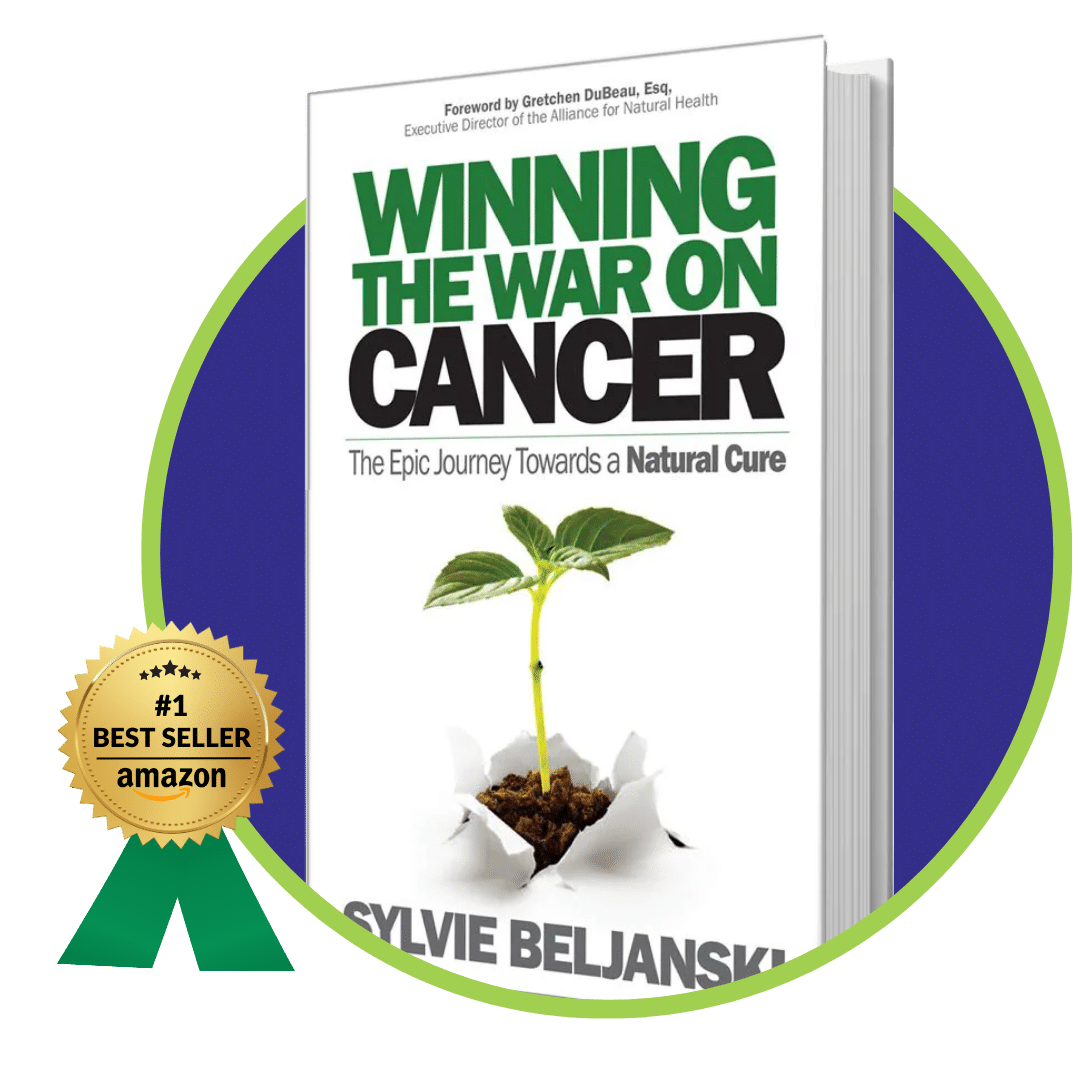
Award-Winning Book On Naturally Fighting Cancer
“For me personally, I think that Winning the War on Cancer by Sylvie Beljanski is one of those books that people should read. I have for a long time believed more in natural remedies than pharmaceutical cures, so I was involuntarily drawn to read the book.
It still preys on my mind on how the government can take up war against something that can save a lot of lives. I mean I know that a sort of thing like a more natural cure would likely actively threaten the pharmaceutical industry, but isn’t the industry on the side of saving people with something that has very little, or indeed no, toxicity at all? It’s so eye-opening and harrowing and I can’t yet state how I feel about everything that I learned.
I would recommend the book to anyone because many people these days are constantly being kept in the dark about natural remedies. What I love most about the book is that, though the book’s main point is cancer and its treatment, it also touches on areas that are vital to leading a healthy life. It points out the importance of detoxifying our body, especially since we live in a world where toxins are constantly released into the air by our technological marvels.”
4 out of 4 stars – Review by Nmesoma – OnlineBookClub.Org